December 30, 2007

Book Review: Life Safari by John Strelecky


Available only at TheLifeSafari.com


Many of us have it on our "to-do-before-I-die" list: go on an African Safari. John Strelecky (as Jack) had it on his list, too. Life Safari is about how he had dreamed of experiencing Africa, when he decided to take the trip, who and what he discovered there, and why it changed his life.


John Strelecky tells us about an old woman, Ma Ma Gombe, an experienced safari guide, who not only showed Jack where the animals were, but also shared the wisdom, and the secrets, of the wild continent. Jack told Ma Ma Gombe that he wanted to walk across Africa to see five animals, his African Big Five. The old woman agreed to help him because doing so meant she would also have the chance to pursue one of her "Big Five for Life"--the five things to see or do to declare one’s life a success.


Life Safari is a simple story that can be read in one sitting; but each chapter, each lesson that Ma Ma Gombe shares, each adventure with the wild animals, hides a deeper meaning. Interestingly, these "deeper meanings" are universal. Readers, no matter their circumstance in life, can relate and find countless takeaways from the book.


Through Life Safari, Strelecky succeeds in inspiring his readers to contemplate on their personal "Big Five for Life." What are the five things you want to see or do to be able to say that your life was a success? Through Ma Ma Gombe’s stories and advice, the book shares some specific strategies on how to pursue them.


It doesn't have to be Africa. You only need to immerse in the story, be amazed at how it often touches on your own dreams of adventure and excitement, and dwell on the magic and mystery of life and the universe. This book is really an essential guide... for a life journey, a life safari, that each of us will have to take.

---
Read my other book reviews at OurSimpleJoys: Inspiration: Book Reviews

November 30, 2007

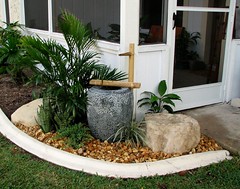
My "tsukubai" Project

I wanted to build a water feature on the corner near the door to our patio. I deliberated on a lot of ideas: a small koi pond, a stillwater pond, a small fountain. I couldn't decide. Then I found a book about "Theme Gardens" and one theme that attracted me was the Japanese "tsukubai" or water basin.

The "official" tsukubai is composed of four rocks, a water vessel, water that flows through a bamboo fixture, and stones or pebbles to unify the whole setup.

The four flat-topped rocks are: a stepping stone, a kneeling stone, a setting-down rock on the right for a pitcher or teakettle, and a slightly higher rock on the left to set down a lantern or candle.

The water basin can be a hollowed out rock or a stone jar or basin. The pebbles between the rocks and the basin are symbolic of a sea in the middle of the rocks. And they serve to absorb the water spills.

The tsukubai is traditionally a water basin built outside a tearoom. Guests wash their hands there before the tea ceremony. It's also found outside temples for the symbolic cleansing of the spirit.

A Japanese-style water basin garden feature would be pretty easy to do, but I still had to figure out the logistics... the rocks and the jar, which were the main elements, would be expensive and difficult to work with.

All of a sudden, from out of the blue, everything came together. With the help of ArtificialRocksFactory.com and a clearance sale of fiberglass stone jars at a neighborhood Super Target store, I was finally able to build my tsukubai.

The article about the step-by-step process is now published in eHow.com:
How to Make a Japanese-Style Water Feature.

Tsukubai Project

October 30, 2007

How-tos at eHow.com

A long time ago, there was Themestream.com. Then there was Webseed.com. After that I got picked up by eRef.com and WriteEdge.com, then Magi21.com. Of course, the whole time I was a mainstay at Suite101.com. Aside from Suite101.com, where my Introduction to Backpacking tutorial still resides, all the content sites I used to work for are now history. The stints were good while they lasted, but true to the volatility of the World Wide Web phenomenon, they, well, evolved.

Now there's eHow.com. I've been hired to be one of their resident "Experts" in the Home & Garden section. I love it because I get to write about how to do the things I enjoy doing. I've always been a home and garden person. I got it from my parents. They gave me the handyman handcrafter gene, and the opportunity to try my hand at anything I'd be curious about. I think it's just about time to share the knowledge and experience I've accumulated over the years.

So, where will you find me at eHow.com? Right here: Ruby Bayan

My two latest articles are:
How to Provide Adequate Lighting to Indoor Plants
How to Find Your Ideal Partner

Many more articles... I'll post the titles here as they get published.

May 31, 2007

Harnessing ADD

Like most parents dreaming of the best for their children, mine wanted me to be a doctor. When I told them I failed both my Qualitative and Organic Chemistry courses, their dreams faded into oblivion. Over the years, I realized I couldn't have been a good doctor, anyway -- and it was their fault... because they gave me ADD.

There was no "Attention Deficit Disorder" back then. We, young ones, were just "distracted" (it was the dawn of color TV!) or "over-stimulated" (good ol' rock 'n' roll!). Most of the time we were just experiencing a surge of hormones. Nobody thought we had some kind of "disorder."

It's only now, in this semi-retirement phase of my life that I finally understood why I've been constantly curious and "highly creative" –- I have ADD. With a craving to learn something new, my short attention span takes me from one body of interest to another. Many times, I would exhaust a passion to the point where I can say, "I've done that," and then I'd move on and try something new. That's not such a bad thing, is it?

Lately, I noticed that I've actually structured my activities to jibe with my ADD. For example, my handicrafts projects (like the bookmarks and notepads I sell online) require drying time, so after I'm done with one task, I can pull out and do something else. When I write or edit, I give it one or two passes, then I pull out and go back the next day with a fresh set of eyes. When I do my jewelry, I have several projects on-going and move from one inspiration to another. In between all these, I cook, surf the 'Net, garden, take photos, workout, and putter about. I'm never bored and I learn something new everyday. It's all so exciting!

In a way, I feel that I've successfully harnessed my ADD. My parents may have been disappointed that I didn't become a doctor, but they’d be happy that I've made the most of the genes they handed down.

So, I should end this here... I feel this big urge to learn metalsmithing. Where's that site I bookmarked?

[Reprinted from my old Blurty journal, May 5, 2005]

April 12, 2007

John Kaizan Neptune

A while back, I scoured the Internet for a CD copy of one of my favorite easy-listening LPs, Mixed Bag, which had one of my favorite love songs, "Soft Melody." But it looked like the LP never made it to CD format.

So, I searched for the artist, John Kaizan Neptune, famous for his romance with the shakuhachi bamboo flute. That led me to his homepage, http://www.jneptune.com, where I found his email address and everything about him and his craft. He's been living in Japan and making his own flutes.

I was bent on finding out how I could get a digital copy of his Mixed Bag album because I had no means to convert the songs from LP to CD, so I wrote him an email. That was in December, 2005.

Last week, I received an answer. I was very pleasantly surprised!

John had been preparing a new album, which will be coming out very soon: Bamboo Magic. He said it was recorded in India and Japan. I'll be looking out for it for sure!

And he sent me some photos! I asked his permission to share them on my blog and he said, yes!


If you haven't heard of John Kaizan Neptune, or his shakuhachi music, you're missing a very essential experience. Trust me.